
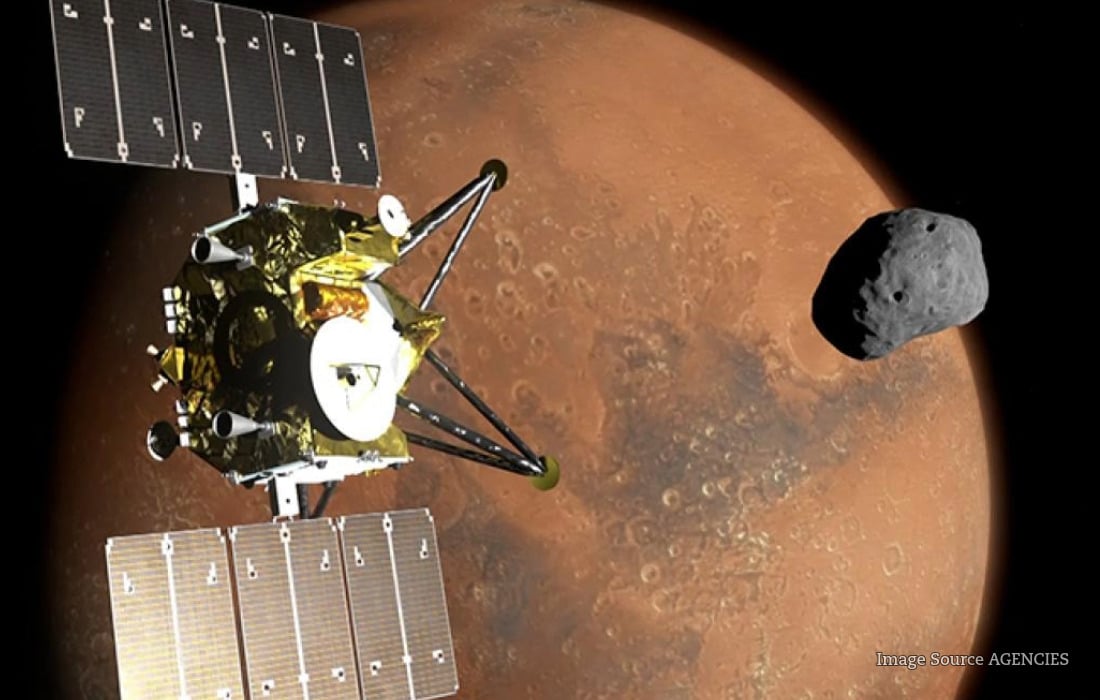
Japan launches its MMX spacecraft to explore Mars’ mysterious moons, Phobos and Deimos, aiming to collect samples from Phobos and return them to Earth by 2031
TOKYO: Japan successfully launched a spacecraft towards Mars on Tuesday, October 20, 2026, beginning an ambitious mission to investigate the planet’s two mysterious moons.
The Japan Aerospace Exploration Agency (JAXA) launched its Martian Moons eXploration (MMX) spacecraft aboard an H3 rocket from the Tanegashima Space Center.
The spacecraft lifted off at 4:41 am Japan time, marking a major milestone in Japan’s interplanetary exploration programme.
What Will the Spacecraft Explore?
The five-year mission will study Phobos and Deimos, Mars’ two small, irregularly shaped moons.
Scientists remain uncertain about their origins. They may be captured asteroids or fragments produced by an ancient collision involving Mars.
The spacecraft will analyse their surfaces and composition to help answer these questions.
It will also deploy a French-German rover named IDEFIX to explore Phobos before attempting sample collection.
When Will Samples Return to Earth?
The MMX spacecraft is expected to reach Mars in August 2027.
After studying Phobos, the mission will attempt to collect at least 10 grams of surface material.
Scientists hope to return these samples to Earth in 2031.
The mission involves international cooperation with NASA and European space agencies.
Researchers will examine the samples for clues about the formation of Mars and the early solar system.
Why Is This Mission Important?
Phobos and Deimos could hold valuable evidence about planetary formation and the history of the Martian system.
Understanding their origins may also support future robotic missions and human exploration.
Impact to Expect
The mission could deliver the first samples ever returned from a Martian moon, improve understanding of Mars’ history and advance future deep-space exploration technologies.
