
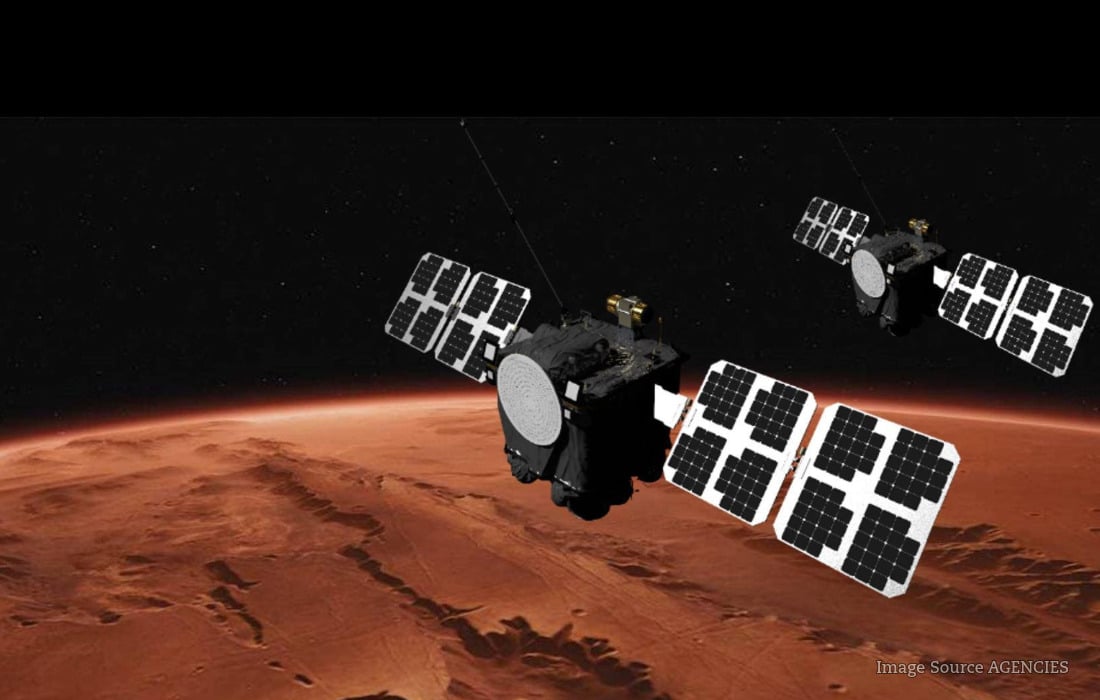
NASA’s twin ESCAPADE spacecraft successfully completed powered Earth flybys, combining gravity and engine thrust to travel towards Mars. The mission could make future Mars exploration more flexible
WASHINGTON: NASA has successfully tested a new spaceflight technique that could improve future missions to Mars. Two spacecraft from its ESCAPADE mission completed powered flybys of Earth, using the planet’s gravity and engine thrust to accelerate towards the Red Planet.
The spacecraft completed the manoeuvres on November 7 and 9, marking an important milestone in NASA’s efforts to develop more flexible routes for interplanetary exploration. Both spacecraft are expected to reach Mars in September 2027.
How NASA’s New Space Travel Technology Works
The twin spacecraft used Earth’s gravitational pull to gain speed while firing their engines for approximately nine minutes during their closest approaches. This combined manoeuvre increased their velocity by more than 1,000 miles per hour and placed them on a trajectory towards Mars.
Traditional Mars missions rely on favourable planetary alignments that occur approximately every 26 months. NASA’s new approach allows spacecraft to launch before these windows, remain in a temporary holding orbit and begin their journey when conditions become suitable.
ESCAPADE Mission to Study Mars’ Atmosphere
NASA launched the ESCAPADE mission in November 2025 to investigate how solar wind affects Mars and contributes to the gradual loss of its atmosphere. The mission’s full name is Escape and Plasma Acceleration and Dynamics Explorers.
Once the spacecraft reach Mars in September 2027, they will prepare for coordinated scientific observations scheduled to begin in June 2028. Their findings could help scientists understand atmospheric changes and the planet’s evolution.
Impact to Expect
The successful test could provide NASA with greater flexibility when planning future Mars missions. It may reduce dependence on traditional launch windows and support more frequent robotic exploration.
The technique does not necessarily shorten the total journey to Mars, but it demonstrates a different approach to interplanetary travel that could benefit future human missions.
