
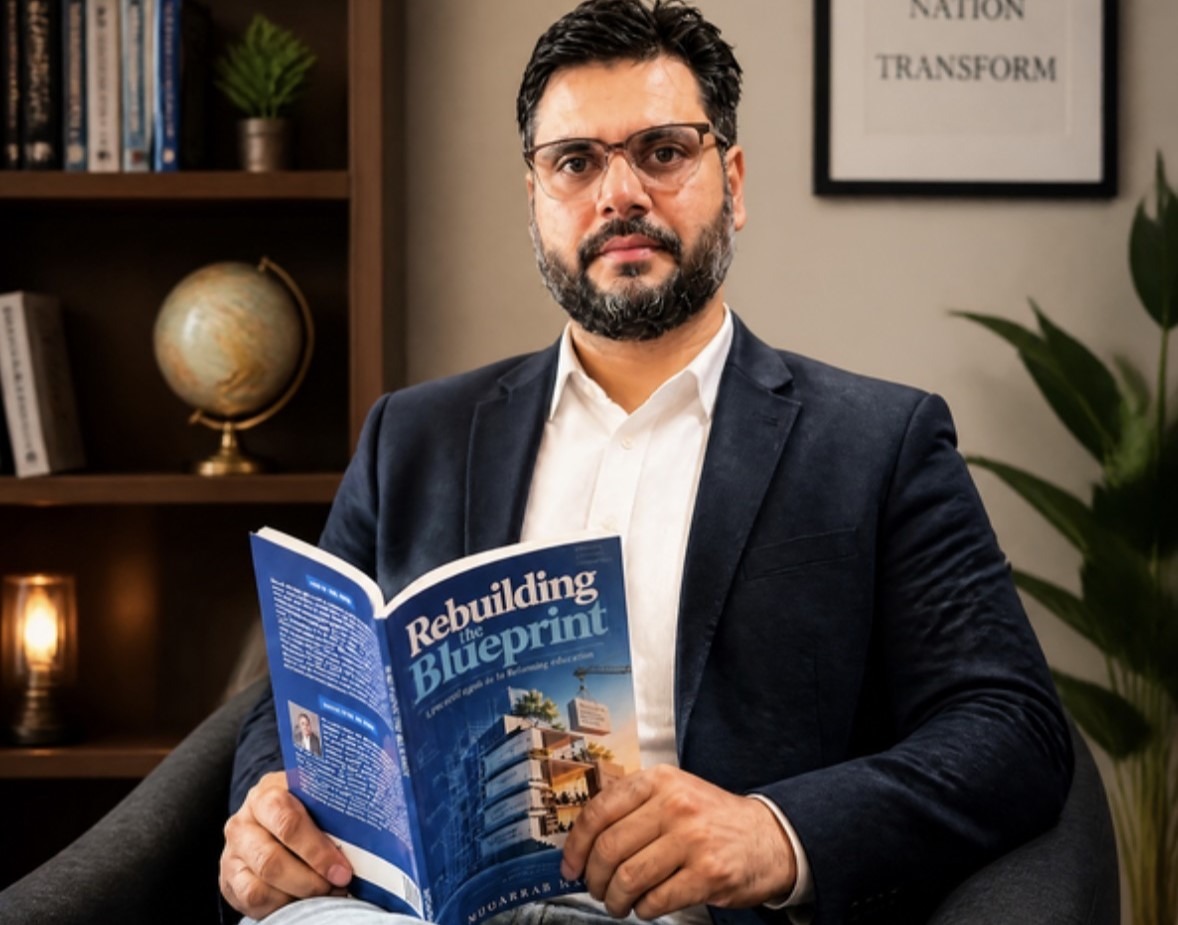
“Our Schools Run on an Outdated Blueprint’: Rampur Educationist’s New Book Calls for System-Wide Change.”, @Muqarrabhadi
RAMPUR: Every morning, millions of Indian children carry heavy school bags into classrooms where the main goal is to finish the syllabus and score marks. Rampur-based educationist Muqarrab Hadi believes this model has run its course. In his new book, Reading the Blueprint, he argues that the time has come to change the way the country educates its children.
Hadi is an engineer by training, a professor, and a director of schools including Hadi Academy, Rampur, and Birr Scholars Academy. He says the book grew out of years of watching bright, curious children lose interest in learning as they moved up through school.
“A child in Nursery asks a hundred questions a day. By Class 9, the same child is afraid to ask even one,” Hadi said. “Somewhere in between, our system teaches them that the right answer matters more than real understanding. That is not the child’s failure. It is a design failure.”
A system built for another time
The book’s central idea comes from Hadi’s engineering background. An engineer, he explains, does not repair a weak structure by painting it. He goes back to the blueprint, finds the fault in the design and redraws it.
“We would never build a modern flyover on a plan drawn a century ago,” he said. “Yet much of our schooling still follows a blueprint made for a very different world, one that needed people to memorise and follow instructions. Today’s world needs people who can think, adapt, work together and care for others.”
The book arrives amid continuing concern among parents and teachers about exam stress, the growing dependence on coaching and the emotional well-being of students. Hadi writes that these are not separate problems. In his view, they are symptoms of a single design that measures children almost entirely by marks.
What the book proposes
Reading the Blueprint does not stop at criticism. Hadi sets out a series of changes that schools, teachers and parents can begin making now.
Among them:
Understanding over memorisation: lessons designed around questions, experiments and real-life problems rather than rote learning.
Assessment beyond marks: recognising curiosity, creativity, effort, teamwork and character alongside test scores.
Respect instead of fear: classrooms where discipline comes from trust and dignity, not punishment and humiliation.
Values as part of learning: compassion, honesty and empathy built into the school day, not left to a weekly moral science period.
Teachers as designers: training and freedom for teachers to plan, test and improve their lessons, much as an engineer improves a product.
Parents as partners: schools and families working together, so that pressure at home does not undo the work done in class.
“Policy matters, but change does not have to wait for a new circular,” Hadi said. “It can begin tomorrow morning, in one classroom, with one teacher who is willing to rethink.”
Three generations in education
For Hadi, the subject is personal. His grandfather was a freedom fighter, and his father has spent five decades working in education. Hadi later studied education in New Zealand, where he says he saw first-hand how classrooms built on trust and inquiry can change the way children learn.
“My grandfather’s generation fought for a free country. My father’s generation built schools for it,” he said. “Our responsibility now is to make sure that our children’s minds are free too: free to question, free to think and free from fear.”
He says the ideas in the book are not theory alone. Many of them have been tried out in the schools he oversees, with teachers adapting lessons, activities and assessment to put understanding and character at the centre.
Part of a larger body of work
Reading the Blueprint is the latest in a series of books Hadi has written for teachers and schools. The Compassion Ladderoffers a class-wise curriculum from Nursery to Class 8 that builds compassion through animals, nature, games and field trips. Qualities of a Great Teacher looks at what makes a teacher truly effective. Beyond the Syllabus is a guide to developing empathy, curiosity and critical thinking in the classroom, while Teaching Without Fear deals with building classrooms where respect replaces fear.
Where the earlier books focus on what an individual teacher can do, the new book steps back to look at the system as a whole.
An invitation, not a blame game
Hadi is careful to say the book is not an attack on teachers, schools or the government.
“Teachers are working harder than ever, and parents want the very best for their children,” he said. “When so many good people keep getting results they are unhappy with, we have to look at the design itself.”
The book is written in simple English for a wide readership, including teachers, principals, school owners, parents and policymakers. Hadi said he hopes it will start conversations in staff rooms and homes across the country.
“If even a few schools read this blueprint honestly and decide to redraw it,” he said, “the children of the next generation will thank us.”
Reading the Blueprint by Muqarrab Hadi is available at Amazon/Flipkart.
